Convert your annual report to a validated iXBRL package.
Chamber of Commerce (KVK) Groot
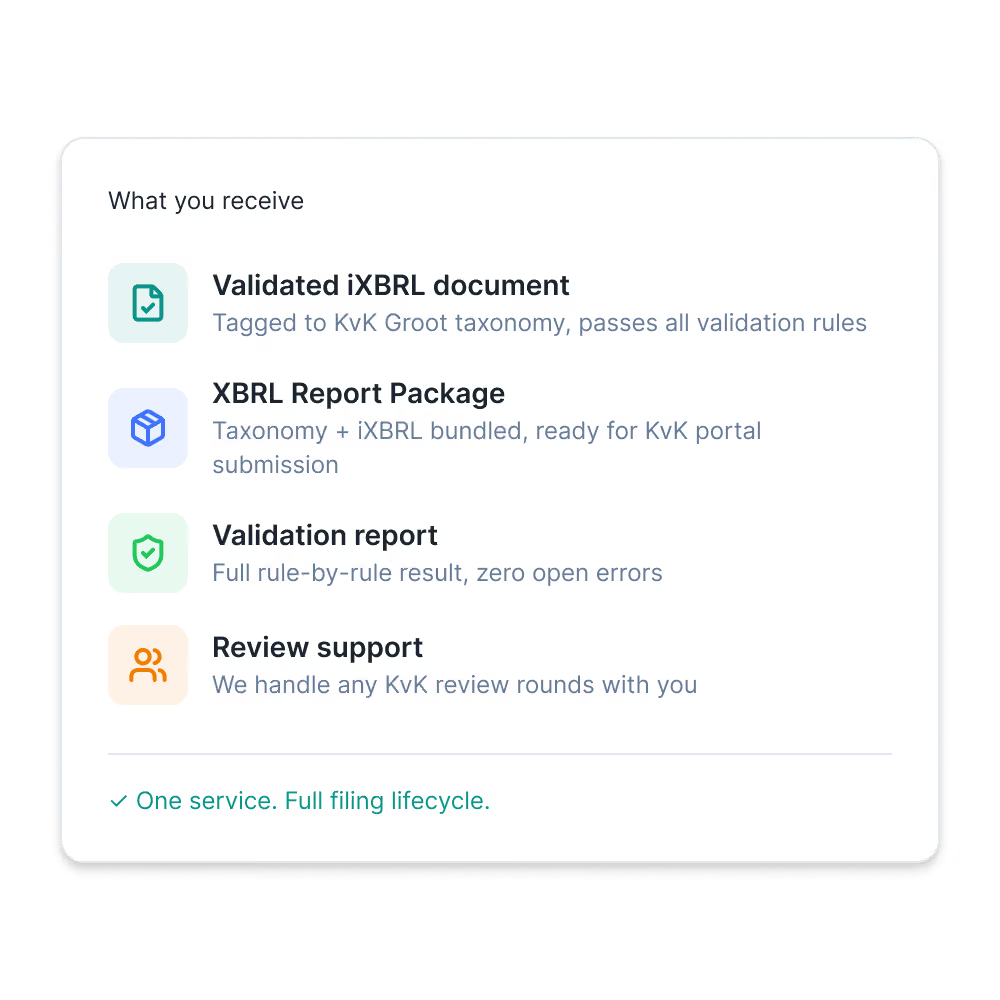
The Dutch Chamber of Commerce (KvK) requires large companies (Chamber of Commerce (KvK) Groot) to file their statutory annual report in Inline XBRL from financial year 2025 onward. The iXBRL Conversion Service handles the full conversion. We receive the annual report in your existing format, return a validated Inline XBRL Report Package that meets the Chamber of Commerce (KvK) filing requirement, and stay with you through any review rounds and the filing itself.
You do not need a platform subscription, an API integration, or an in-house XBRL specialist. You send the document, we send the Report Package.

ESEF annual reports
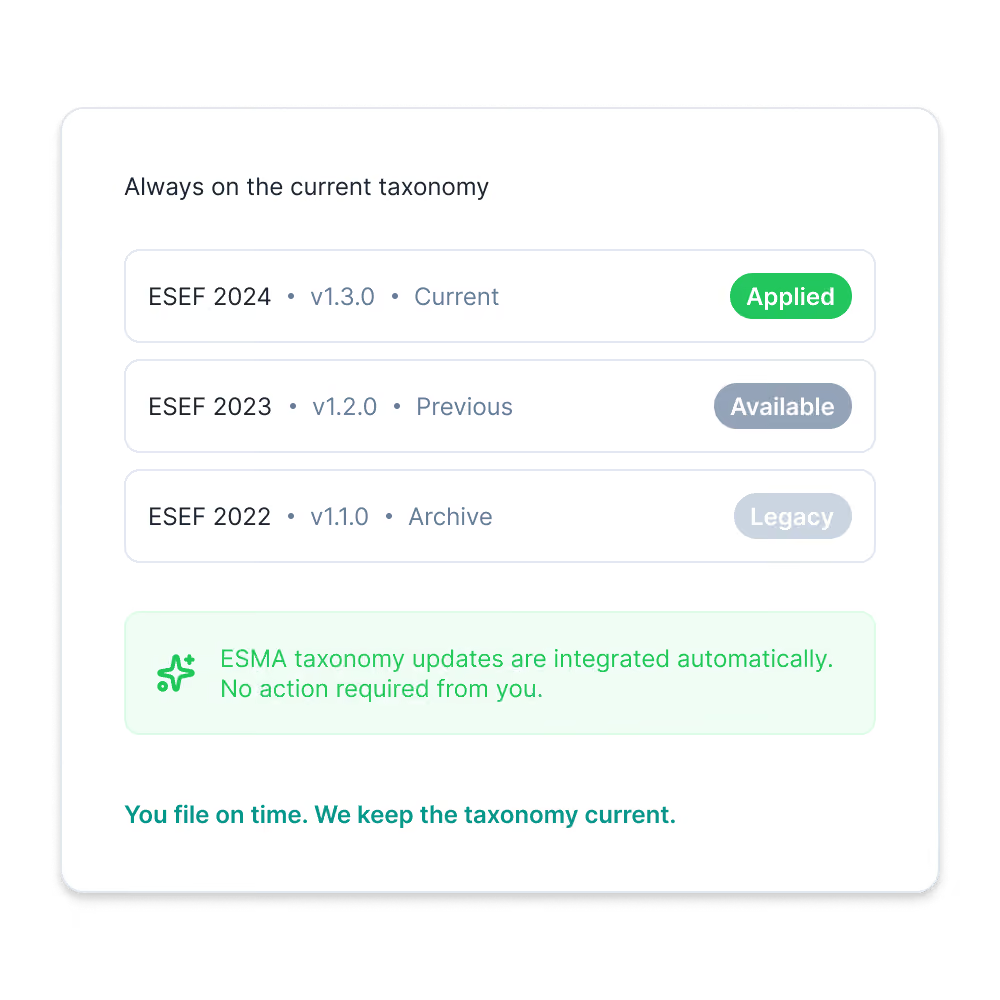
EU-wide regulated-market issuers preparing their annual financial report in iXBRL on the ESEF taxonomy. Conversion handles full ESEF tagging, taxonomy validation, ESMA-published taxonomy version updates, and the iXBRL output ready for filing through the national OAM.
Dutch Ministry of Education, Culture and Science (OCW) education-sector filings
Education institutions and accounting-services firms filing on the published Dutch Ministry of Education, Culture and Science (OCW) taxonomy, Dutch education-sector reporting to OCW (onderwijsverantwoording).

Custom taxonomies
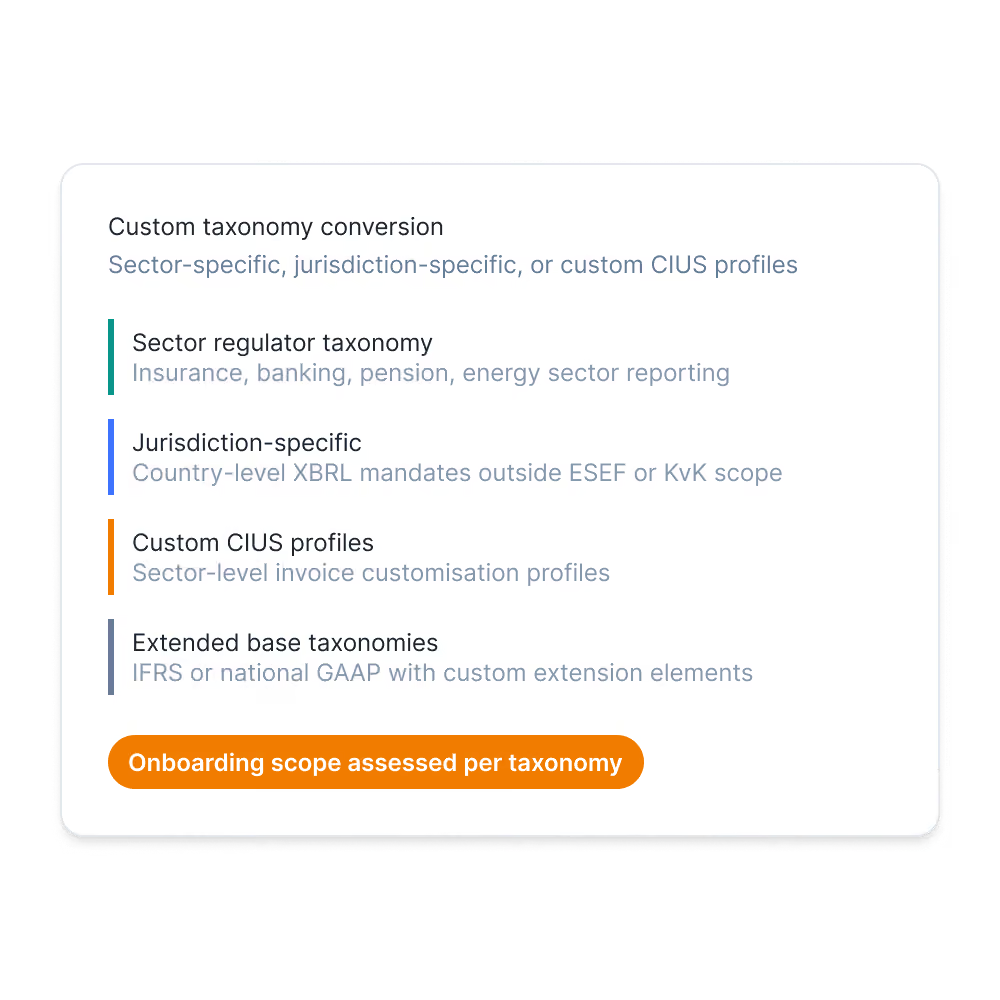
Sector-specific reports, jurisdiction-specific filings, custom CIUS profiles. Onboarding lead times depend on taxonomy complexity. Contact sales for scope.
How the iXBRL conversion process works
No portal, no API. You submit one document. You receive one Report Package.
Intake and scoping
Every conversion begins with a clear definition of the reporting obligation, the source material and the expected deliverable.
During the intake, we confirm the reporting entity, reporting period, filing authority, submission destination and applicable accounting or reporting framework. We also establish the required taxonomy and taxonomy version, the tagging scope, the source format, the expected Report Package structure and the filing deadline.
At this stage, we agree how the project will be managed. This includes identifying the people authorised to approve taxonomy and mapping decisions, defining how review comments will be handled and determining how late changes to the source report will be incorporated. Where filing support is required, the responsibilities of Semansys and the reporting organisation are documented in advance.
The source report is also assessed for complexity. We review its length, structure, languages, financial statements, notes, tables, typography, images, internal references and entity-specific disclosures. Reports with complex multi-column layouts, extensive graphics or highly designed tables may require additional preparation to function correctly in a browser-based filing environment.
The outcome of the intake is a documented scope, delivery schedule and commercial proposal. This creates clarity before production begins and reduces the risk of late-stage surprises.
Source preparation and XHTML conversion
Semansys can work with commonly used source formats, including Microsoft Word, PDF, Microsoft Excel, HTML, XHTML and selected outputs from publishing or reporting systems. Suitability depends on the document structure, content quality, filing framework and agreed conversion scope.
The source report is assessed for conversion readiness and prepared for controlled transformation into XHTML. The objective is not simply to recreate the appearance of the original file. The XHTML document must also contain a logical reading order, usable navigation, properly structured tables and content that can be tagged and processed reliably.
During this phase, headings, paragraphs, tables, images, footnotes, internal links and other presentation components are converted while preserving the report’s approved content and visual identity as closely as the applicable filing rules permit.
Special attention is given to elements that do not always translate cleanly from print or PDF into XHTML. These can include complex tables, multiple columns, special characters, page-dependent references, custom fonts, embedded graphics and content positioned for a fixed-page layout.
Where necessary, small presentation adjustments are discussed with the client. The objective is to maintain the communicative integrity of the annual report without introducing fragile XHTML or elements that conflict with filing requirements.
The result is a human-readable XHTML report that forms the presentation layer of the final iXBRL filing.
Taxonomy analysis and XBRL tagging
Once the document structure has been prepared, our specialists analyse the applicable taxonomy and map the disclosures in the report to the appropriate XBRL concepts.
We use standard taxonomy concepts wherever they faithfully represent the accounting or reporting meaning of the disclosure. A concept is not selected simply because its label resembles the wording in the annual report. Its definition, accounting meaning, period type, data type and relationships within the taxonomy must also be appropriate.
Where the reporting framework permits entity-specific extensions, these are introduced only when no suitable standard concept is available. Extensions are therefore treated as controlled reporting decisions rather than convenient alternatives to taxonomy analysis.
Depending on the filing regime and agreed tagging scope, the process may cover monetary and non-monetary facts, dates, percentages, shares, text facts, narrative disclosures, accounting policies, primary financial statements, explanatory notes and detailed tables. Depending on the filing regime, it may also include extension taxonomies, presentation relationships, calculation relationships, dimensional structures and anchoring.
For each tagged fact, we determine the relevant concept, reporting entity, period, unit, format, decimals, scale, sign and dimensional context, where applicable. These properties are fundamental to the meaning of the extracted data. A visible value can appear correct while the underlying structured fact contains the wrong period, scale or sign.
This is therefore a semantic process rather than a simple text-matching exercise. The objective is not to apply the greatest possible number of tags. It is to create the most accurate structured representation of the report within the applicable taxonomy and filing rules.
Material, unusual or judgement-sensitive mappings are identified for focused review with the client.
Structural, taxonomy and filing-rule validation
Validation is performed throughout production and again on the completed Report Package.
Structural validation verifies that the Inline XBRL documents and supporting files conform to the relevant XHTML, Inline XBRL and XBRL specifications. Taxonomy validation examines the schemas, linkbases, relationships, concepts and extension components included in the package.
The report is also checked against the technical and business rules published for the relevant filing framework or receiving authority. These filing rules may address naming conventions, permitted files, report-package structure, taxonomy entry points, tagging obligations, prohibited content and other authority-specific requirements.
Fact and context validation assesses the properties that determine the meaning of the structured data. This includes contexts, units, reporting periods, dimensions, scales, signs, decimals and duplicate facts. Calculation and consistency checks are used where applicable to identify relationships that do not reconcile as expected. A calculation inconsistency is treated as a review signal and does not by itself prove that the visible financial statements are incorrect.
Automated semantic and business-rule checks are supplemented by expert review. This is important because a report can pass a basic technical validator while still containing a poorly selected concept, an unnecessary extension or a fact that does not represent the approved disclosure correctly.
The rendered report is also compared with the source document. We review tables, headings, footnotes, special characters, internal navigation, links, images and the visibility of tagged facts. Package-level checks confirm that the required files are present, internal references resolve correctly and prohibited or unnecessary resources have not been included.
Validation findings are classified according to their severity. Blocking errors are distinguished from warnings and review points that require professional judgement. Passing a validator is an important control, but it is not treated as proof that every semantic and presentation decision is correct.
Client review and remediation
Once the initial conversion and validation have been completed, the client receives a review version of the report.
The finance, accounting or reporting team can compare the visible iXBRL report with the approved source and review the structured treatment of material disclosures. Particular attention is generally given to significant line items, entity-specific reporting, extension concepts, changed accounting treatments and disclosures that required judgement during mapping.
Where appropriate, Semansys provides supporting information on taxonomy decisions, extensions, validation findings and open review points. Technical validator messages are translated into clear reporting consequences so that the client can make informed decisions without having to interpret low-level XBRL diagnostics.
Comments are processed through a controlled remediation cycle. Changes are applied to the XHTML, tagging or taxonomy components as required, after which the affected elements are validated again.
Annual reports often continue to change during audit, governance approval and final publication. Where the underlying source report is revised, Semansys assesses the changes and updates the iXBRL report through the agreed change-control process.
This ensures that the final package reflects the approved report rather than an outdated production version.
Final validated Report Package
Following remediation and the client’s approval of the agreed visible content, material mappings, extensions and release version, Semansys produces the final validated package.
Depending on the applicable filing framework, the package may include one or more XHTML or Inline XBRL documents, extension-taxonomy schemas, presentation and calculation linkbases, definition and label linkbases, permitted images, stylesheets, fonts, package metadata and other supporting resources.
Before release, we confirm that the final content corresponds with the approved source, that the agreed taxonomy and taxonomy version have been applied and that all approved review comments have been processed.
We also confirm that the agreed validation procedures have been completed, the package structure meets the applicable requirements and the delivered package is the version intended for submission.
The completed filing package is delivered through the agreed secure channel, together with any validation or delivery documentation included in the scope.
Optional filing support
Where required, Semansys can remain involved during the submission process.
This support may include a final pre-filing package check, assistance during upload or submission, interpretation of filing-portal messages and analysis of authority-generated errors or warnings.
Where a receiving system identifies an issue, Semansys can investigate whether the cause lies in the report, taxonomy, package structure or authority-specific validation rules. Where remediation is required, we can produce and validate a revised Report Package through a controlled release process.
The precise responsibilities for filing are agreed during the intake. Unless explicitly included in the service scope, the reporting organisation remains responsible for authorising and completing the statutory submission.
Acceptance by the receiving authority remains subject to the authority’s own systems, controls and filing procedures.
Frequently asked questions
Regulatory reporting is the preparation and submission of information that an organisation is required to provide under applicable laws, regulations, supervisory rules or official reporting frameworks to a regulator, supervisory authority, tax authority, chamber of commerce, statistical agency or other designated body.
Examples include annual financial statements, tax filings, prudential reports, sustainability disclosures, and statistical reports.
Semansys supports the creation, validation, conversion, review, and submission of structured regulatory reports.
The platform provides taxonomy access, business-rule validation, document generation, format conversion, filing-channel integration, submission-status monitoring, and audit information. These capabilities can be used through the browser or integrated into automated reporting processes through APIs. Learn more about Semansys e-reporting.
XBRL, or eXtensible Business Reporting Language, is an open international standard for digital business reporting.
It provides structured and unambiguous definitions for reported information, allowing financial, risk, performance, sustainability, tax, and compliance data to be exchanged accurately between systems. Read the XBRL International introduction.
Inline XBRL, usually abbreviated to iXBRL, brings human-readable presentation and machine-readable XBRL facts together in the same report or report set.
Readers can view the XHTML report in a browser while compliant software identifies and processes the embedded tagged facts. This enables organisations to retain control over presentation while meeting structured-data requirements. Learn more about Inline XBRL.
A traditional XBRL document is primarily designed for machine processing. Its facts, relationships, contexts, units, and metadata are represented in a structured format.
An iXBRL document embeds XBRL facts in a human-readable XHTML report, serving both human readers and automated systems.
The applicable filing requirement determines whether XBRL, iXBRL, or another structured format must be used. See the XBRL International format guidance.
An XBRL taxonomy is the structured dictionary and rule framework used for a specific reporting requirement.
It defines reportable concepts, technical properties, labels, references and relationships, and may include dimensional structures, calculations and formula rules. Additional filing and business rules may be published separately by the relevant authority. Taxonomies are issued by regulators, standard setters, governments, and industry bodies and are updated periodically.
Yes. Semansys validates reports against the relevant technical specifications, taxonomy requirements, and filing rules.
Depending on the applicable taxonomy and validation profile, validation can identify technical specification errors, invalid contexts or units, dimensional inconsistencies, duplicate facts, calculation inconsistencies, formula-rule failures, filing-rule violations and report-package errors. Mandatory-disclosure checks are available where the relevant taxonomy or filing rules define them. See the Semansys validation API.
Yes. Specific Semansys software products hold current XBRL Certified Software™ status for the modules listed on their individual XBRL International certification pages. Certification applies to the named product version, certification type and specification modules shown on those pages.
XBRL International’s certification programme independently tests software against defined conformance requirements. Visit our Trust and Security page.
ESEF is the European Single Electronic Format for annual financial reports.
Relevant issuers prepare their annual financial reports in XHTML. Where reports contain IFRS consolidated financial statements, those statements are marked up using the ESEF taxonomy and Inline XBRL technology. Read the ESMA Electronic Reporting guidance.
Yes. Semansys supports ESEF report preparation, iXBRL generation, taxonomy mapping, validation, technical review, and production of the final report package.
Semansys monitors ESEF requirements, taxonomy releases and relevant ESMA guidance and updates supported validation and production profiles in accordance with its release and support policy.
Yes. The Semansys iXBRL Conversion Service transforms an existing annual or regulatory report into an Inline XBRL Report Package that is validated against the agreed specifications, taxonomy and available filing rules and prepared for submission. Final acceptance remains subject to the checks performed by the receiving authority and submission channel.
The process includes document analysis, taxonomy selection, mapping, tagging, technical generation, automated validation, expert semantic and visual review, and delivery of the package prepared for submission.
No. Dutch Chamber of Commerce filings are one use case, but Semansys supports different reports, taxonomies, and regulatory frameworks.
Not reliably. A PDF is primarily a presentation format and does not necessarily contain the semantic structure needed for regulatory reporting.
Automation accelerates extraction, mapping, and repetitive processing, while professional review safeguards the treatment of tables, accounting policies, footnotes, custom disclosures, dimensional information, and taxonomy extensions.
Required inputs normally include the final source report, applicable taxonomy or filing regime, reporting period, entity information, accounting basis, currency, and any relevant prior-year filing.
Additional information may be needed for entity-specific disclosures, taxonomy extensions, unusual table structures, or information that cannot be interpreted unambiguously from the source document.
For Dutch Chamber of Commerce filings, the conversion scope should explicitly address the auditor’s report. KVK requires the auditor’s report to be filed in the same format as the annual accounts. The package composition, tagging treatment, signing process and responsibilities should therefore be agreed before conversion starts.
No. Semansys validates the package against the agreed specifications, taxonomy and available filing rules. Final acceptance remains subject to the submission channel and receiving authority.
Semansys prepares and documents mapping proposals as part of the agreed service. The reporting organisation remains responsible for accounting judgements and should approve material, ambiguous and entity-specific mappings.
Each production round should use an identified source version and controlled change process. Changes after initial conversion may require regeneration, retagging, validation and renewed review.
The service aims to preserve the report’s intended presentation, but XHTML is not a fixed-page format like PDF. Complex layouts, custom fonts, absolute positioning and unsupported external dependencies may require controlled adaptations.
No. Automated validation identifies technical and rule-based issues. Accounting meaning, extension choices and judgemental mappings require expert and client review.
Yes. Semansys supports direct regulatory delivery and filing-channel integration for supported reporting regimes.
Where a regulator requires an authorised filer to use its own portal, Semansys produces the completed filing package for upload by the customer, auditor, filing agent, or authorised representative.
Why Semansys
A discovery call walks through the report you need to file, the destination taxonomy, the expected delivery timeline, and the tier that fits. The call produces a written scope and a fixed-price quote you can take into procurement.
Audit-grade controls.
ISO 9001, ISO 20000-1, ISO 22301, and ISO 27001 certified. ISO 27701 and ISO 42001 compliant. SOC 2 Type II and SOC 3 attestations on request. Audit pack available. The conversion service inherits these controls; conversion logs are retention-managed under the same policies as the rest of the platform.
Multi-jurisdiction coverage.
The same engine handles Chamber of Commerce (KvK) Groot, Dutch Ministry of Education, Culture and Science (OCW), ESEF, Standard Business Reporting (SBR) and SBR Nexus, UK FRC, EIOPA Solvency II and IORP II, and custom taxonomies. One engagement, multiple taxonomies if your scope requires it.
XBRL International Certified Software.
Certified software behind every conversion.
Twenty-five years of compliance heritage.
Built by a team that has been delivering compliance software since 1997.