Know your data is right before it ever leaves your organisation.
The challenge
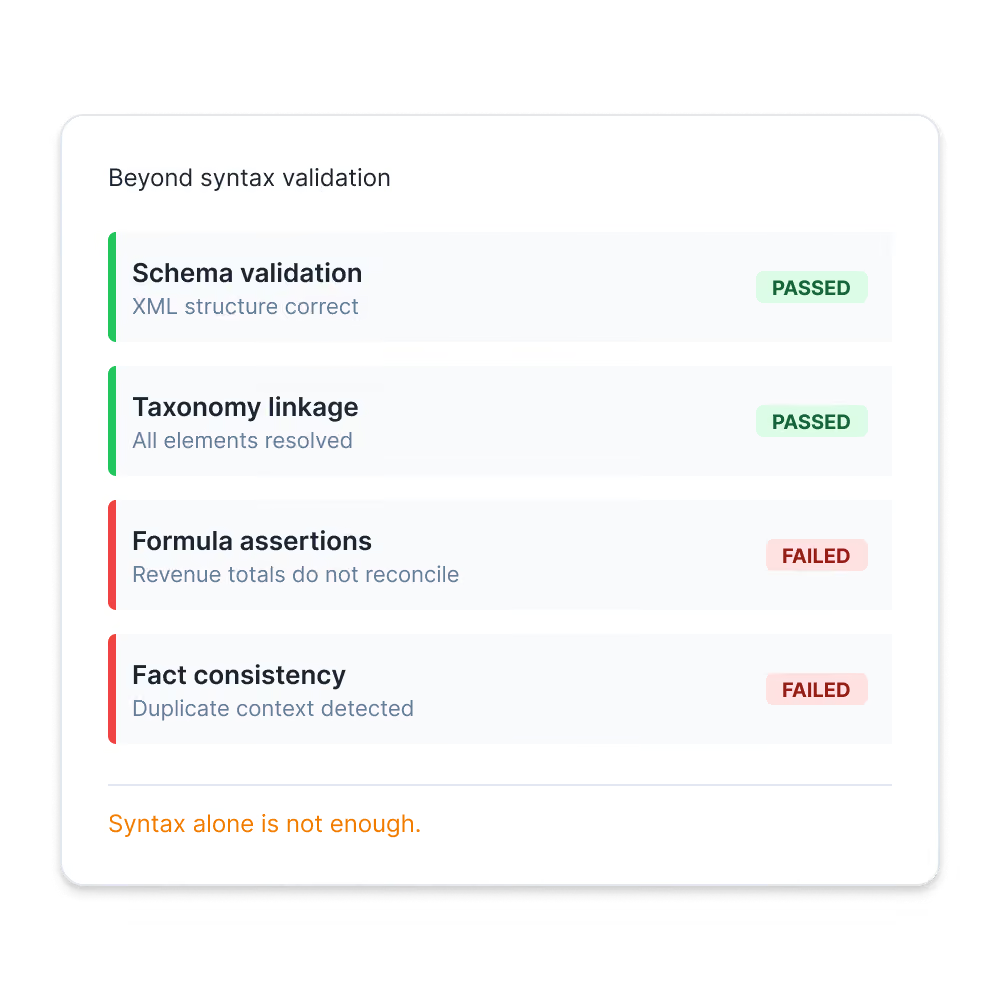
XBRL and Inline XBRL reports are structurally complex artefacts. They must satisfy multiple, overlapping rule sets simultaneously: the XBRL 2.1 specification, dimensional constraints, formula assertions, unit-type requirements, filing rules set by individual regulators, and the specific calculation linkbases embedded in each taxonomy. No single check is sufficient. A document that passes core syntax validation may still fail on formula assertions or carry duplicate facts that distort an automated analysis downstream.
Most organisations discover these issues only when a submission bounces. By then, the cost in time, rework, and reputational exposure is already real.

What Semansys validation does
Our validation engine runs a comprehensive, layered inspection across every dimension of XBRL correctness. A report is not declared valid until it has passed every applicable gate.
XBRL core validation checks structural conformance against the XBRL 2.1 specification, covering namespace resolution, element types, context integrity, and unit references.
Dimensional validation verifies that every reported fact sits within the dimensional space defined by the taxonomy, catching misaligned typed dimensions and hypercube violations before they reach a regulator.
Inline XBRL validation inspects iXBRL documents for correct tagging, hidden-element handling, and continuations, ensuring the human-readable report and the machine-readable data layer are in full agreement.
Calculation validation confirms that reported numeric values are arithmetically consistent with the calculation linkbases declared in the taxonomy. Rounding discrepancies are reported with precision.
Formula assertion validation executes the full XBRL Formula specification, running value assertions, existence assertions, and consistency checks defined by regulators and taxonomy publishers.
Unit Type Registry (UTR) validation verifies that all numeric facts use the correct, registered unit types. This is a frequent source of silent errors in cross-border filings.
Duplicate fact detection identifies redundant or conflicting fact–context pairings that would distort consumption by data aggregators, regulators, and analytical platforms.
Filing rules validation applies the jurisdiction-specific business rules published by regulators such as ESMA (ESEF), the Dutch Tax Authority, the Chamber of Commerce (KvK), and others. These rules are often changed at short notice and must be applied precisely.
Non-present fact detection flags facts that are reported in the instance document but absent from the presentation linkbase, a common indicator of taxonomy misalignment or taxonomy extension errors.
Report package validation validates complete XBRL Report Packages (including ESMA ESEF and SBR-NL 2.0 packages), inspecting the manifest, the taxonomy references, and the embedded instance documents together.
Targeted and actionable results
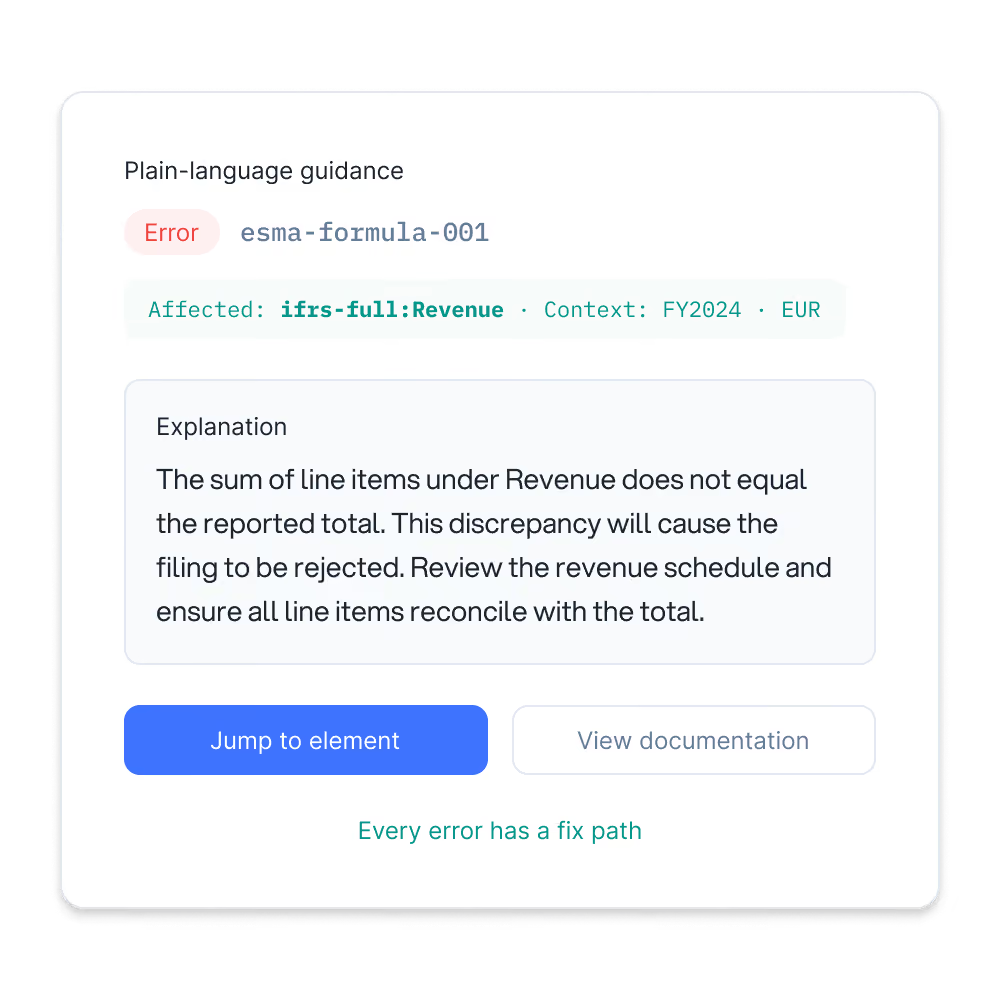
Validation results are returned with granular, machine-readable diagnostics. Every error and warning carries a severity level, a rule reference, an affected element, and a human-readable explanation. Results can be filtered by severity, rule category, or element, so a developer integrating our API gets exactly the signal needed to drive automated remediation, and a reporting officer reviewing via the portal can act immediately.
Hash-based validation tracking enables intelligent caching: re-submitting an unchanged document does not trigger redundant processing.
Why it matters
Trusted by PwC, Nationale Nederlanden, and more than 5,000 customers across Europe.
Our certifications
Certified
TYPE II
9001:2015
27001:2022
20000-1:2018
22301:2019
42001:2026
27701:2025