Every taxonomy. Maintained, versioned, and ready.
Semansys takes that burden entirely off your hands.
What makes taxonomy management hard
A taxonomy is not a single file. It is a distributed, interconnected set of schemas, linkbases, and label resources, often spanning multiple namespaces and referencing international base taxonomies maintained by XBRL International and IFRS Foundation. Regulators customise these base taxonomies with local extensions and publish new versions on their own schedules, with their own versioning conventions.
For an organisation managing filings across multiple jurisdictions (or a software vendor embedding XBRL capabilities in a product deployed across many customers), the taxonomy layer is a significant operational overhead. Failing to track a taxonomy update means filing against an obsolete ruleset. Failing to implement an extension taxonomy correctly means validation errors that are opaque to anyone who does not understand the underlying structure.
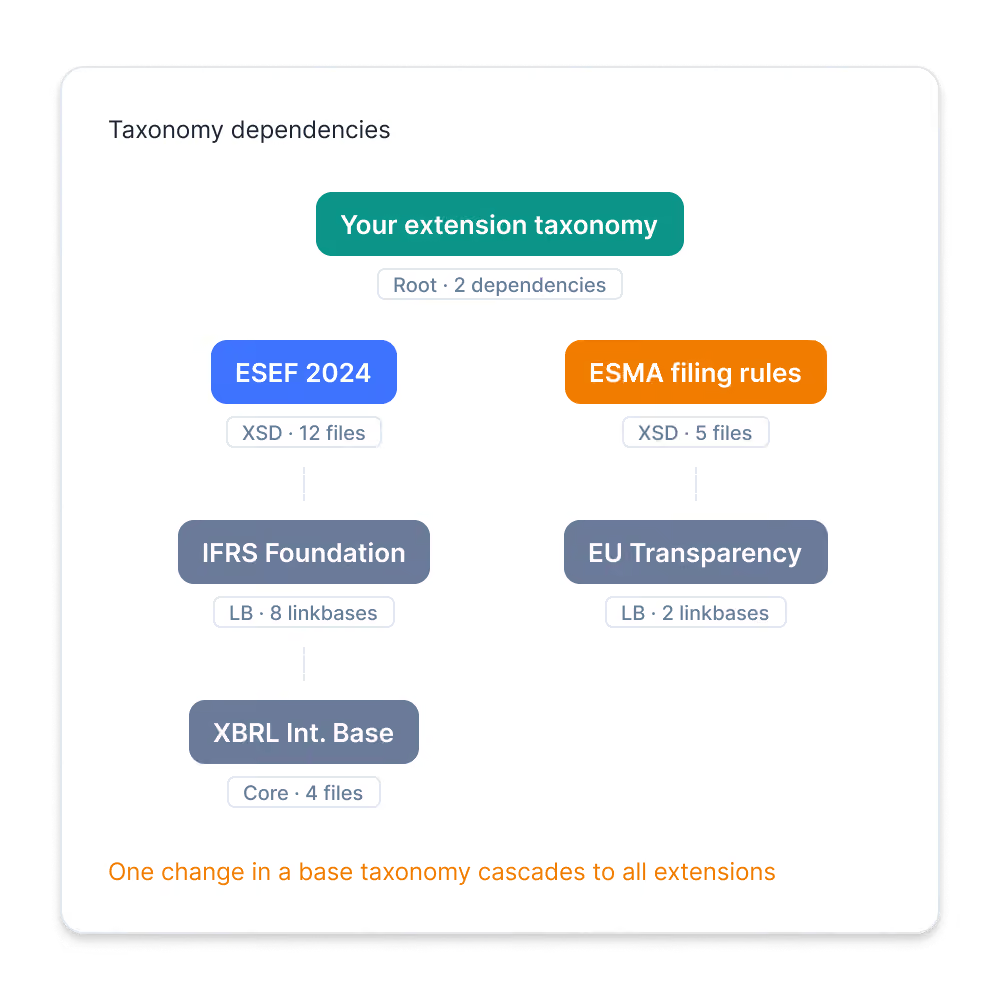

Semansys taxonomy capabilities
Comprehensive taxonomy library. We maintain a continuously updated library of regulatory taxonomies across all supported jurisdictions. You access the correct, current version of the taxonomy you need, without managing downloads, version conflicts, or local caches.
Full taxonomy introspection via API. The Semansys API exposes the complete structure of any supported taxonomy: entry points, schema sets, presentation linkbases, calculation linkbases, definition linkbases, label resources, and concept-level metadata. This enables downstream applications to build dynamic reporting forms, perform data mapping, and enforce taxonomy constraints programmatically, without embedding static taxonomy artefacts.
Taxonomy extension support. Regulators and listed companies frequently need to extend standard taxonomies with company-specific or jurisdiction-specific concepts. Our platform supports the full XBRL extension taxonomy pattern (new concepts, new link roles, new presentation relationships, and pivot tables) and validates extension documents against both the base taxonomy and the extension constraints defined by the relevant regulator.
Table and presentation rendering. Taxonomy presentation linkbases encode the intended layout of financial statements and disclosure tables. We resolve these structures and expose them as rendered table definitions, enabling applications to generate correctly structured data-entry forms or disclosure previews directly from the taxonomy, with no manual layout work required.
Calculation and definition linkbase access. Calculation linkbases define the arithmetic relationships between reported facts. Definition linkbases define dimensional structures and hypercubes. Both are exposed through the API with full navigational fidelity, supporting advanced use cases such as automated cross-validation, dimensional data modelling, and comparative analysis.
CSV export for data mapping. Taxonomy concept sets, including dimensional placeholders, can be exported in CSV and ZIP formats, providing a practical bridge between the taxonomy and the spreadsheet-based or database-driven data pipelines that most organisations use to assemble reporting data.
Entrypoint discovery. For any supported taxonomy, the platform returns the full set of available entry points with their associated metadata, parameters, and table-of-content structures, giving integrating applications an accurate, up-to-date map of what can be filed and where.
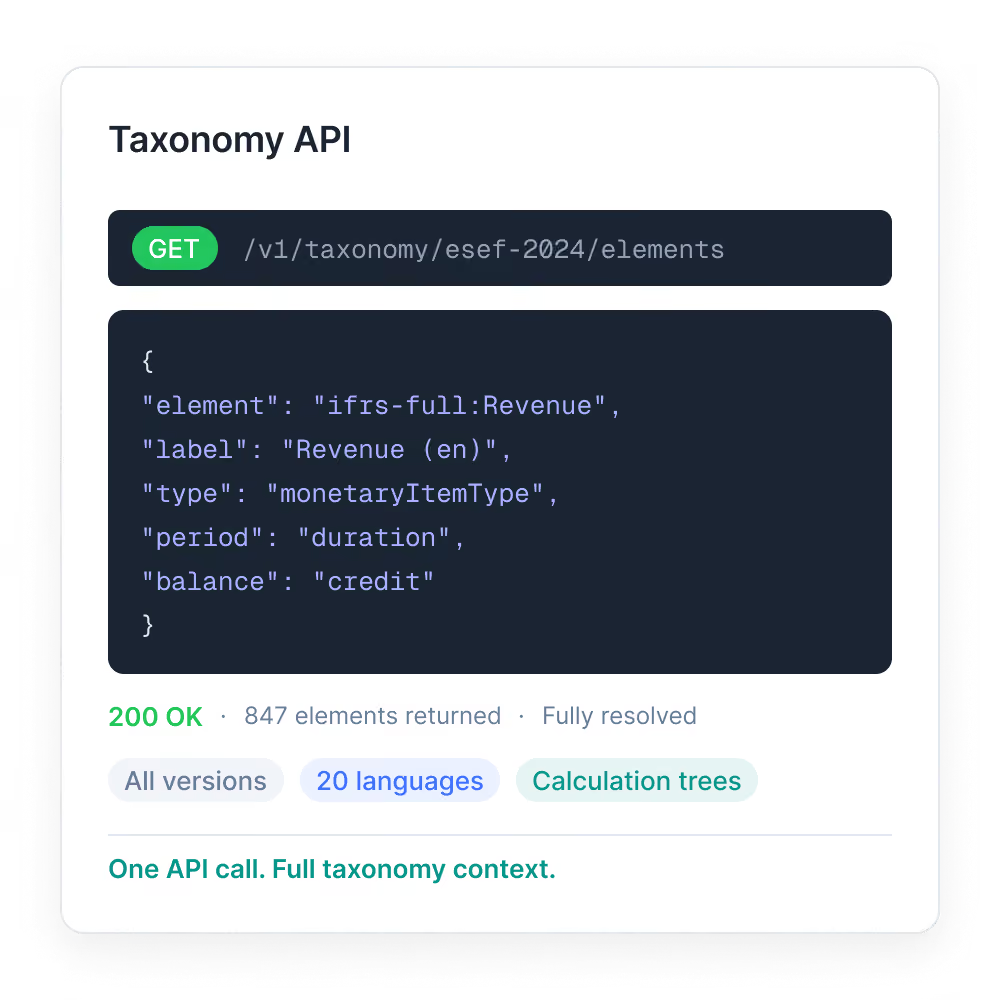
For software vendors and integrators
If you are building XBRL capabilities into your own product, our taxonomy API is the component you have been looking for. Rather than embedding and maintaining taxonomy files within your own application (a commitment that compounds over time as taxonomies evolve), you can resolve taxonomy structures at runtime through a single, maintained endpoint. Your product is always current. Your team is not burdened with taxonomy maintenance.
Supported taxonomies
Our certifications
Certified
TYPE II
9001:2015
27001:2022
20000-1:2018
22301:2019
42001:2026
27701:2025